.:[Double Click To][Close]:.
Tampilkan postingan dengan label Review. Tampilkan semua postingan

Jumat, 06 Mei 2011

Haunted 3D Movie Review Bollywood Film

Veteran actor Mithun Chakraborty’s son might have changed his name from Mimoh to Mahaakshay, but this cannot save ‘Haunted’ from its fate at the Box Office.

After making an unsuccessful debut in ‘Jimmy’ (2008), Mimoh almost disappeared from the silver screen, cropped his long locks, lost oodles of weight and even changed his name in a desperate attempt to make a second coming in Bollywood, but to no avail.

In Vikram Bhatt’s 3D scary caper ‘Haunted’, Mahaakshay plays Rehan, an MBA, who lands a job of selling a haunted mansion known as Glen Manor. However, in order to sell the house, Rehan has to exorcise the house of

evil spirits and for this; he has to travel back in time in order to fix events that took place eighty years ago.
The
incident talked about in the film took place in 1936, where a lusty music teacher (Arif Zakaria) violated his student (Tia Bajpai), who then took revenge by killing him.

However, the despicable teacher comes back as a ghost and wrecks havoc for almost six days before his student commits suicide. And the teacher’s spirit continues to rape his student’s spirit till eternity.

‘Haunted’ lacks clear and coherent script as it lacks inherent logic in the storyline. And to top it all, the film portrays Ramsay-style ghosts, complete with clichéd horror machinery - books falling by themselves, mist, roaring wind and screeching doors, something which has been done to death in Hindi films.

Even as Mahaakshay struggles to get his act right, it is Pravin Bhatt’s cinematography and Chirantan Bhatt’s background score that keeps the film alive. Acting wise, barring Arif Zakaria and Achint Kaur, there is hardly any actor who leaves an impact. Watch ‘Haunted’ at your own risk!

Rating: Two cheers for this one!

-Spicezee

Haunted 3D

Jumat, 29 April 2011

Shor in the City Movie Review Bollywood 2011

The city of Mumbai continues to captivate filmmaker’s imagination. The story of ‘Shor in the City’ makes Mumbai also a character. With its bustling city life, it becomes a poignant character of the plot. The plot revolves around some interesting characters and their separate stories which are in some way interwoven with each other.

So we have three small time crooks (Tusshar Kapoor, Nikhil Dwivedi and Pitobash Tripathi) chancing upon a big loot on the local train. The three steal a bag from a local train, just for kicks, and find it to be full of guns in all shapes and sizes. The three now want to sell their loot to suitable buyers.

Then there is an NRI (played by Senthil Ramamurthy of TV series ‘Heroes’ fame) who wants to set up his business in India, without paying security to the local mafia (Zakir Hussain) . The encounter between the NRI and the local mafia make up for interesting scenes and keeps the pace of the movie edgy.

Tusshar outshines and proves yet again that he can act and do any role with much élan. The scenes with his wife (Radhika Apte) bring a smile on the viewers face. Nikhil Dwivedi and Pitobash Tripathi also give convincing performances.

Senthil Ramamurthy`s track is quirky, especially his encounters with gangster Zakir Hussain who can`t understand why the NRI can`t understand his code that rules Mumbai.

The screenplay of the film is worth a mention. It keeps the film edgy and gripping through. Kudos to producer Ekta Kapoor for making a film so real. She has certainly come a long way from Saas Bahu sagas.

-Spicezee

Shor in the City

Jumat, 21 Januari 2011

Dhobi Ghat Movie Review Bollywood Movie

Dhobi-Ghat-Movie-Traile

The metropolis of Mumbai is a city of dreams, a known fact to all- a million dreams thriving and a million about to be seen. But the complexities of this Indian city are far beyond description. Debutant filmmaker Kiran Rao has succeeded in portraying those untold yet evident stories that are an integral part of the city. ‘Dhobi Ghat’ is indeed an intelligently woven piece of art.

Aamir Khan plays Arun, an upmarket artist who has a chance encounter with Shai, played by debutant Monica Dogra. Shai is a NRI investment banker who meets up with Arun at one of his exhibitions and the two enter a strange relationship after their one-night stand. Prateik, portrays the character of Munna, who is a dhobi, and an aspiring actor. He befriends Shai and the duo end up becoming good friends.

Another debutant, Kirti Malhotra plays Yasmin, a loner who has suffered a failed marriage. The story revolves round the complicated lives of the four protagonists who earnestly keep looking for what they are badly in need of.

Amidst the ocean of humanity in a city that is known for its cosmopolitanism, the four actors portray characters that are nothing but real. Their individual stories have been etched with great care against the backdrop of the madly crowded city. Munna meets his ends by working as a washer man, who has a strange equation with Shai, despite diverse financial backgrounds. Shai is busy with her claustrophobic love life while Arun is lost in his own world of the canvas. And Yasmin tries to engage herself in all sorts of domestic activities only to supersede her agony over her broken marriage. The four protagonists in the film are souls wandering aimlessly in search of their needs.

The striking yet most traumatic story is that of Yasmin, who sends video letters addressed to her brother Imran telling him about her loneliness. Arun discovers those video tapes of Yasmin, who happens to be an ex-tenant of the house where he is put up. He falls in love with her sensuousness and finds in her his muse.

Kudos to Kiran Rao for handling such a sensitive subject with great conviction and passion. The characters in the film have been wisely used and each of them has justified their bit. The story is dumbfounding as it is about a man’s constant race towards his dreams. The actors are excellent, the story prim and proper and the cinematography is speechless.

In a nutshell ‘Dhobi Ghat’ is poetry.

Ratings: Four cheers for this one.

Jumat, 07 Januari 2011

No One Killed Jessica Movie Review

no-one-killed-jessica

Director: Raj Kumar Gupta; Actors: Vidya Balan, Rani Mukerji; Rating: *** 1/2

On April 29, 1999 a shot was fired from a .22 bore pistol whose loud reverberations lasted over a decade. The shot that killed a vivacious, aspiring model Jessica Lall was fired in the presence of more than 100 ’socialites’ present at a party in New Delhi. Yet, accused Manu Sharma walked free in 2006 prompting a newspaper headline that read "No One Killed Jessica".

In the ensuing decade, Venod Sharma, father of the accused and a high profile congress leader, paid millions of rupees to silence witnesses. It was not until the Tehelka Magazine did a sting investigation and Star News aired the footage that justice was finally served.

"No One Killed Jessica" faithfully follows the case to emerge a winner.

Almost everyone knows the story. Yet, the film makes some interesting departures to keep the momentum going. A Barkha Dutt type character has been introduced in Rani Mukerji though the former did not have much to do with the case or its reinstatement. However, Rani lacks the intensity to pull off such a strong role and the strain shows.

On the other hand, Vidya Balan soars with the unglamorous, distraught and hunchbacked portrayal of Jessica’s sister.

Director Raj Kumar Gupta makes direct comment on the society we live in, its voyeuristic tendencies and the judiciary’s disregard for justice. Everyone knows the extent of corruption and rot in the system as symptomised by the acquittal of Manu Sharma, but the question as always is who would bell the cat if the police and judiciary do not.

In this case Tehelka, who did the sting investigation and Star News (and not NDTV that walks away with the praises in the film) that aired the footages did manage to right a wrong. But the question is not just of Jessica Lall, but the thousands like her whose cases have not had the light of justice shine upon them.

The Jessica Lall murder thus became an emblem of the rot in the democracy, police and judiciary.

The truth is, the culprits were not just Manu Sharma, his friends and his family, but Shayan Munshi who redacted his statements leading to Manu’s acquittal and Bina Ramani, both of whom continue to have successful careers, one as an actor-model and the latter as a heedless socialite. The culprit is all of us who stay silent to the injustice all around us.

The injustice done in Jessica’s case has been corrected, but the question remains of the millions of other cases of injustice in the country.

Gupta’s film on a true incident bodes well for Bollywood, which is normally not too keen on reality, and the concept of justice itself. Yet, the question is not who killed Jessica Lall, but as the gross miscarriage of injustice in Kashmir, central and northeast India and the thousands of pending cases in the country show -- it is: who killed justice in India?

Jumat, 03 Desember 2010

Movie Review: Rakht Charitra 2

RakthaCharitra2hindimovie

Movie: Rakht Charitra

Director: Ram Gopal Varma

Cast: Vivek Oberoi, Suriya, Shatrughan Sinha, Abhimanyu Singh


We’re back in Anantpur where the saga of revenge continues. We’re shown a close-to 30-minute recap of the first instalment that led some of us in the screening to believe that Part 1 was being screened all over again.

A recap is necessary if you’re showing the film in two instalments, just not this detailed.

So you are reminded of the rivalry between politician Narsimha, his loyal worker Veerbhadra, and Naagmani who instigated Narsimha against Veerbhadra.

Lives are taken and Veerbhadra’s son Pratap (Vivek Oberoi) kills Naagmani and Narsimha in retaliation. He is helped by a powerful politician and becomes a minister. Post half-hour, the credits for Rakht Charitra 2 roll out.

We see a car bomb planted to kill Pratap, which he escapes. His people find out that the bomb was planted by Narsimha’s son Surya (Tamil actor Suriya) thirsting for revenge.

The story track has several similarities with Part 1 where it was Pratap who was distraught after the murders of his father and brother and wanted to even the score. So, the revenge and counter-revenge episodes continue as people on either side are murdered in the most gruesome manner.

The story also has similarities with Ram Gopal Varma’s Company that released in 2002. Those who have seen the film will remember that it was a small misunderstanding that led mentor and protégé to become sworn enemies.

Here too, half-truths lead either side to ruthlessly mow down each other. Add to that a chain-smoking DCP with a stylish swagger who appears and disappears at will, and you get the feeling that he’s a shade of the cop in Company who is getting either side to surrender.

Mercifully Part 2 is less violent that the first, which was a series of murders and rapes. And there are a couple of scenes that really have you at the edge of your seat, like the one where Suriya is escorted to the court.

The camera, that’s always hand-held and edgy in Ram Gopal Varma’s films, goes topsy-turvy this time. So you have two people conversing with the camera swerving till it’s completely upside down!

Performances are an absolute treat. South superstar Suriya is outstanding, flashing the wrath of his character through his expressive eyes.

Vivek Oberoi gives a nuanced, powerful performance in this instalment as well. The two are dynamite on screen, which is why one rues the lack of an equally solid script that could exploit the potential of this duo.

The characters of Pratap and Suriya are fashioned along similar lines: Both were on their way to becoming educated professionals till revenge got the better of them, both marry girlfriends who defy their families to be with them, and both have mothers who support their violent ways.

Writer-director Ram Gopal Varma is inevitably drawn towards fashioning his male characters around these attributes: The kind that are tough with the world, but committed to their women.

So there you have it, a revenge drama that’s not a patch on Varma’s earlier works like Satya and Company. And even though the performances are superlative, one cannot recommend a film on that account alone.

Verdict: 2.5 stars

Movie Review: Khelein Hum Jee Jaan Sey

Khelein_Hum_Jee_Jaan_Sey

Movie: Khelein Hum Jee Jaan Sey

Director: Ashutosh Gowariker

Cast: Abhishek Bachchan, Deepika Padukone, Sikander Kher, Vishakha Singh


Adapting a work of literature into a movie is an arduous task. Satyajit Ray’s ’Apu Trilogy’ (Pather Panchali, Aparajito, and Apur Sansar) was based on two Bengali novels written by Bibhuthibhushan Bandopadhyay. Ray’s Shatran Ke Khiladi was based on Munshi Premchand’s short story of the same name. In fact, film-makers have always been fascinated by best-selling books/novels for adapting into feature films. Mira Nair’s The Namesake, P.C. Barua, Bimal Roy and Sanjay Leela Bhansali’s Devdas, Pradeep Sarkar’s Parineeta, Rajkumar Hirani’s 3 Idiots, Atul Agnihotri’s Hello and the recent Aisha have been adapted from literary works. Even in Hollywood, Lord of the Rings, Harry Potter, Narnia and many more have been successfully adapted from novels by reputed names.

However, if you analyze the past, you will realize that not all movies adapted from novels/short stories have set the cash registers jingling at the box-office. Films like Pinjar, Paheli, Raincoat and international experiments like Bride And Prejudice and The Mistress Of Spices have found very few takers in the past.

This is not the first time Ashutosh Gowariker has adapted a book into a film. Khelein Hum Jee Jaan Sey is yet another book-to-movie adaptation by this talented storyteller (this one is based on the book Do And Die: The Chittagong Uprising 1930-34 by Manini Chatterjee). Again, this is not the first time Ashutosh Gowariker has revisited the bygone era. He did it successfully in Lagaan (period), then Jodhaa Akbar (historical) and now Khelein Hum Jee Jaan Sey (period).

Recreating the bygone era is indeed demanding, laborious and strenuous. It’s a challenge to present the era convincingly. Besides extensive detailing to lend authenticity, the director carries the responsibility of making the characters come alive to the present-day generation. Gowariker has successfully done that in the past and does it successfully yet again in Khelein Hum Jee Jaan Sey.

Once the film-maker takes on the task of depicting a chapter from history, it’s imperative that he/she remains factual to the depiction of the revolution, giving an accurate account of what actually transpired in that period. But details alone won’t help, it needs to be well dramatized for the big screen. There’s a vast difference in the style novels are written, but one needs to take extra care to make it film friendly. While I may not be able to comment on whether Gowariker has been faithful to the book or tampered with it or implemented some changes, which may be necessary to suit the tastes of the present-day spectators and make it more palatable, I would definitely like to say that what comes across on screen is very absorbing, truly informative and exceptionally inspiring.

Final word? The expectations from Khelein Hum Jee Jaan Sey are minimal, but you can’t overlook the fact that it’s a genuinely honest effort that needs to be encouraged and appreciated. I would like to add here that the promotional posters/billboards/promos don’t create any impact whatsoever. Wish the makers would’ve looked into this very important aspect as well!

1930, British India: In the province of undivided Bengal lies the sleepy, peaceful port of Chittagong. In this unassuming little town, a revolution is about to begin; a revolution which will forever wake all of Chittagong and inspire the entire nation.

April 18. One night. Five simultaneous attacks. A band of 64 - 56 innocent yet fearless young boys, five defiant revolutionaries, two determined young women, and an idealistic leader (Surjya Sen), a school teacher by profession.

This group of 64 represents a little-known chapter in history; a forgotten night that reigned terror on the British through a series of calculated attacks. This is a true story of these forgotten heroes and the narrative takes us through every step of the action from the initial trepidation, to the thrill of the attack, to the underground movement, daring escapes and tragic captures, and most importantly, their undying legacy.

A film-maker of extensive aptitude and sensitivity, Gowariker’s tryst with period films continues. Seems like he has worked himself to the grind in order to attain perfection. The writing (screenplay: Raoul V Randolf and Ashutosh Gowariker) and execution of the material are so credible that it influences you to wonder if the writers and director were part of the revolution. The Bengali ethos and the behavioral patterns of the characters, recreating the etiquette and body language of people who lived in a different era along with their attire and styling and also their dwellings come across as very pragmatic. In fact, Gowariker has left no stone unturned to make a film that does justice to the event.

Khelein Hum Jee Jaan Sey has almost entirely been shot in Goa and not Chittagong (now Bangladesh) because the location that was there in the 1930s no longer exists in that shape, I understand. However, the film captures the spirit and intensity to perfection. On the other hand, with Gowariker’s films, the length/running time of the film is always a topic of discussion and that’s a problem with Khelein Hum Jee Jaan Sey as well. The film has a running time of approximately 2.48 hours and the editor (Dilip Deo) and director could’ve easily trimmed a few fight sequences in the second half, to make the goings-on crisper.

Musically, Khelein Hum Jee Jaan Sey is embellished with soft and soothing compositions, but I have an issue with that. Sure, the album is high on patriotic sentiment, but the songs in the first hour act as a roadblock in the narrative. Ideally, it should’ve been a songless film. However, the background score (also by Sohail Sen) enhances every scene, making it more impactful. The production design (Nitin Chandrakant Desai) transports you to that era. It’s that authentic. The stunts (Ravi Dewan) are true to life. Kiran Deohans and Seetha Sandhiri’s cinematography captures the era to perfection.

Abhishek as Surjya Sen suits the character right. His character appears very fervent, but at the same time truly tranquil, incredibly unperturbed and really unruffled, which merges very well with the character of an educationalist that he illustrates. A freedom fighter with these attributes hasn’t been presented in a motion picture before. Abhishek gets to the character a certain authority. The rebelliousness and boisterousness are depicted to perfection.

Deepika sheds her glam look and looks every bit the character she illustrates. Kudos to her first of all for accepting a challenging role (of a woman revolutionary of the 1930s) so early in her career and then almost living that character in the film, continuing to prove her mettle far ahead of her poise and exquisiteness.

Sikander Kher leaves a terrific impression. He excels in several scenes. Vishakha Singh is a complete natural. She catches one’s attention instantly. Samrat Mukerji, Maninder and Feroz Wahid Khan, each actor is earnest and sincere to the core. In fact, every actor in the film looks most convincing in their respective parts. I would like to make a special mention of the young artists (most of them seem like first-time performers), who have a very unpolluted/uninfluenced approach to acting. Brownie points to each one of them.

On the whole, Khelein Hum Jee Jaan Sey, based on the Chittagong rebellion, is an enlightening experience of a poignant, but little-known chapter in history. It’s a film of immense significance which evokes a colossal patriotic fervor. A motion picture like Khelein Hum Jee Jaan Sey isn’t created targeting the box-office solely. It’s also made for the gratification of the senses. And that it does in sufficient measure. In an industry obsessed by opening weekend business and box-office records, this is one of those rare films that doesn’t compromise on its gracious objectives for the sake of becoming more box-office friendly. At the same time, a film like Khelein Hum Jee Jaan Sey, although very well made, may not appeal to those who relish the customary kitsch and masala. Therefore, the film will have to rely on a very strong word of mouth to create any kind of an impression or impact at the box-office.

Verdict: Fours stars

Jumat, 19 November 2010

Guzaarish Movie Review

Guzaarish-2010-movie-poster

Film: "Guzaarish"; Cast: Hrithik Roshan, Aishwarya Rai, Aditya Roy Kapoor, Monikangana Dutta, Suhel Seth; Director: Sanjay Leela Bhansali; Rating: *****

Breathe a sigh of relief. During a year when cacophonic crassness masquerading as comic entertainment has been sanctioned by critics and the masses, "Guzaarish" comes along to remind us that excellence is alive in our cinema.

Ironically this wonderful work of art, nuanced and magical in its portrayal of an unstoppable spirit’s quest to juice life to its fullest, is about dying. If the journey towards death in art can be so mystically explored, then let’s embrace mortality as a stepping stone to immortality and a film about dying as a sign of cinema not dying on us. Not yet.

Only those who suffer the numbing pain of isolation would know what it feels like. Dilip Kumar in "Devdas", Guru Dutt in "Pyasa", Meena Kumari in "Sahib Bibi Aur Ghulam" and Nutan in "Bandini" communicated to the audience the indescribable pain of solitude.

Ethan, as played by Hrithik Roshan in "Guzaarish", is so bemused by adversity that he can actually look at his own suffering with dispassionate humour.

"Guzaarish" is a joyous, rapturous and ecstatic celebration of life. Those familiar with the art of Sanjay Leela Bhansali know how ably and ecstatically he transports his characters into a universe of seamless drama played at an octave where most cinematic symphonies crack up and topple over into high-pitched extravagance.

Not Bhansali’s cinema. Played at the highest possible scale, his drama unfolds in wave after wave of rapturous splendour. His characters occupy a space that defies definition and seduces audiences into celebrating a state of sublimity and splendour. Ethan’s inert physicality is alchemized into an ambience of animated joy. His spirit dances and sings at the sheer pleasure of every moment that is given to him to live. He radiates joy. We feel his profound happiness at the gift of life.

No film in living memory has brought out the sheer blessing of being alive with such spirit and glory. While Shah Rukh Khan’s "Devdas" in Bhansali’s opulent opera was a character broken in spirit, Hrithik’s Ethan in "Guzaarish" is irreparably damaged in body. But his spirit soars, his eyes light up like thousands of stars every time Sophie walks in.

That Sophie is played by Aishwarya Rai is a stroke of genius that goes a long way in giving "Guzaarish" its flavour of exceptional elegance. No other director brings out the quiet grace and the understated beauty of this screen diva’s personality with as much intelligence and spontaneity as Bhansali. In "Guzaarish", Aishwarya is far more delicate and nuanced in conveying the unspoken pain of a love that has no tomorrow than she was in "Devdas".

Aishwarya imbues her role with a resplendent grace. Love in "Guzaarish" is expressed with subtle smirks, gentle smiles and hints of a smothered passion that could erupt any time, if only destiny didn’t choose to be so mean to the spirited.

The scenes between Ethan and Sophie, the backbone of Ethan’s spine-challenged life, radiate an inner beauty and wisdom and underline the director’s enormous understanding of the self-negation that a love relationship requires.

"Guzaarish" is Bhansali’s most tender and evocative film to date. It layers the pain of a dying body with the passion of an unstoppable spirit as manifested in Hrithik’s skilled and effortless performance as a quadriplegic who pledges to make every moment of his limited "sau gram zindagi" pleasurable for himself an those around him.

Barring Amitabh Bachchan in "Black" there has never been a better performance in a Bhansali film than Hrithik’s in "Guzaarish". He grabs Ethan’s role and makes the dying character come alive in delightful waves of provocative histrionics. And if we’re talking chemistry between Hrithik and Aishwarya, then let’s get one thing clear - this ain’t "Dhoom". It’s something far deeper and satisfying.

The other performance that catches your attention is Aditya Roy Kapoor’s. He is natural and vivacious and in-sync with the film’s spirit of celebrating life. Monikangna Dutt is a looker. In her limited space, she lends some appeal to the proceedings. Suhel Seth, Shernaaz Patel and Rajit Kapur also make a lingering impact in a film that you carry home with you in an inviolable place in your heart.

A word about Bhansali’s music score. The songs communicate the rich tapestried emotions of lives that are determined to smile through an extraordinary tragedy. Every piece of music and song in "Guzaarish" echoes the film’s incandescent soul.

The film’s technical excellence, particularly Sudeep Chatterjee’s cinematography, is not dazzling and flamboyant in the way it was in "Devdas". In "Guzaarish", the appeal is far more delicate and subtle. The deep but sober colours on screen reach out to you to enrich your life in ways that cinema was always meant to, until it was waylaid by the hooligans and imposters posing as filmmakers.

"Guzaarish" is the real thing. A big, beautiful, dazzling emotional movie experience. You won’t see a better film this year.

Sabtu, 24 Juli 2010

Movie Review: KHATTA MEETHA


Corruption is rampant in many countries today. No work is possible without chai paani (bribe). Everyone must have experienced this ubiquitous nuisance. KHATTA MEETHA, a remake of the 1989 Malayalam drama film, VELLANAKALUDE NADU (which was again directed by Priyadarshan) is a satire on this perpetual menace. While it was a novel issue back then, it’s been done copious times over the years.

Sachin Tichkule (Akshay Kumar) is a struggling road construction contractor in a small town who has taken loans practically from the entire village. But he still manages to wear sunglasses! Trigun Fatak (Manoj Joshi), Sachin’s brother-in-law, is a corrupt chief engineer who works in the municipality. Suhas Vichare (Milind Gunaji) is a road contractor married to Sachin’s second sister. Anjali (Urvashi Sharma) is Sachin’s college-going sister.

While Sachin struggles through his never-ending woes, things go haywire. A bridge collapses because of bad construction, taking many innocent lives. Figun, Suhas and others who were involved in the construction, conveniently pass the buck to Vishwas Rao (Tinu Anand), who is a driver of the Tichkule family and later kill him. Azad Bhagat (Makrand Despande), who has lost his wife and son in the bridge mishap, is determined to bring to justice the criminals behind the scam.

The common man’s troubles remain the central plot of the film. As if Sachin’s miseries weren’t enough, the new municipal commissioner turns out to be his ex girlfriend Gehna Ganpule (Trisha) who now loathes him.

The successful director-actor jodi of Priyadarshan and Akshay Kumar (HERA PHERI, BHOOL BHULAIYAA, DE DANA DAN) fails to entertain this time. Priyadarshan falls short to render the issue of corruption, which Rajkumar Hirani did effectively in portions of LAGE RAHO MUNNABHAI. It has the right intent but offers nothing which we haven’t seen. The screenplay gets monotonous with Sachin Tichkule constantly borrowing money, his numerous tiffs with Gehna, perverted acts of Rangeela (Rajpal Yadav) and random songs.

That a corrupt politician has maintained a file of all the wrong doings of his accomplices including himself, is inexplicable. It’s ludicrous to see Azad Bhagat easily getting inside a politician’s house and stealing important documents. The climax is too convenient to grasp.

There are a few laugh-out-loud moments like the one in which the road roller rams through Gehna Ganpule’s house or when Karodimal (Asrani) is attending countless calls at the same time. But that’s just about it.

With an excruciating long running time of 2.40 hours, the film drags. Music by Pritam except for the song Nana Chi Taang, is very poor according to his standards. Only V Manikanandan’s choreography is neat.

Akshay Kumar’s comic timing is impeccable but he is very loud. Trisha, who makes her Hindi film debut, is passable. She looks too young to be a municipal commissioner! Urvashi Sharma is decent. Johny Lever, who is seen after a very long time, is uproarious. Wish we could see more of him. Rajpal Yadav gives a superlative performance. Makrand Despande is effective in his small role. Manoj Joshi is impressive while Kulbhushan Kharbanda is good.

KHATTA MEETHA isn’t sour or sweet. It’s simply bland.

Jumat, 16 Juli 2010

Bollywood Movie Review: LAMHAA


Kashmir has always been a favourite topic with Indian filmmakers. But most of the films we came across, till date, either talked about India-Pakistan divide or terrorism. Rahul Dholakia, whose last outing PARZANIA was based on the hostile Gujarat environment during the 2002 riots, now comes up with LAMHAA, set in the Kashmir valley. The film has been in the buzz from quite a long time.

Vikram (Sanjay Dutt) is sent to investigate a highly confidential mission using the identity of Gul Jehangir after the Military Intelligence intercepts a plot that is likely to terrorise Kashmir. The day that he lands in the valley, Haji (Anupam Kher), a top separatist leader, survives a blast. Aatif (Kunal Kapoor), Haji’s ex-apprentice, now wants to have his own party. Vikram teams up with Haji’s daughter Aziza (Bipasha Basu), to investigate this baffling and ominous plot.

The film tries to touch upon many issues, from scheming politicians, to the appalling condition of the army men, to sex scandals, and what not thus ending up being convoluted. The sequence of events is so bewildering that at the end of the first half, you don’t really know what the intentions of the characters are. The climax is predictable and fails to create any impact.

Vikram isn’t from Kashmir but his knowledge about it is impressive. The romantic angle between Vikram and Aziza is ludicrous. They are having a serious conversation and out of nowhere, Vikram says that like Kashmir, Aziza too, is beautiful.

The screenplay by Raghav Dhar and Rahul Dholakia isn’t smooth as the sequence of events defies logic. Editing is hideous. It seems that they have just patched up different scenes which make little sense. Mithoon’s music is soulful. Kashmir looks even more beautiful in the song ’Madno’. However, the perpetually shaky camera movements are superfluous and get on your nerves.

Sanjay Dutt is decent in the film but we have seen him playing similar roles in the past. Also, his character seems shallow. Bipasha Basu is pretty convincing in her de-glam avatar. Watch out for the scene in which she is humiliated for going against her former party. Kunal Kapoor is good but falters while delivering his political speeches. Anupam Kher is impeccable.

Apart from bringing some already prevailing issues of Kashmir to the big screen, LAMHAA doesn’t offer much to rave about.

Kamis, 15 Juli 2010

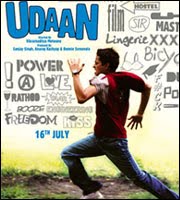
Bollywood Movie Review: Udaan


Director: Vikramaditya Motwane

Cast: Rajat Barmecha, Ronit Roy, Ram Kapoor, Aayan Boradia

Rating:4 star

Much against our will, at several instances in life, one has to helplessly bow down to some entity – be it your teacher, boss, kin or anyone else. Udaan narrates a tale where a son is almost on an extended detention under his disciplinarian father’s domain. Through this allegory, Udaan inspires one to break away from all bindings of life and fly freely.

In its very first scene, four teenagers jump off their hostel compound wall to indulge in an adult film. Caught by the warden, they all are expelled from their school. One of them, Rohan (Rajat Barmecha) is sent back to his hometown Jamshedpur where his father (Ronit Roy), whom he hasn’t met for years, isn’t much happy to have him back. Rohan is also introduced to a younger stepbrother Arjun (Aayan Boradia), who he never knew existed.

Much against his aspirations of being a writer, Rohan is forced to study engineering and work part-time in his father’s factory. The tyrant rule of his father cuts off all the independence he enjoyed in his school days. As life turns more and more claustrophobic under the roof of his dominating father, the only respite he finds is in his uncle (Ram Kapoor) and college senior (Anand Tiwari).

The story of Udaan can be encapsulated as the unspoken track in 3 Idiots where the disciplinarian dean (Boman Irani) loses his son whom he tries to mould in his way rather than letting him live his life. Interestingly, Udaan doesn’t merely restrict the father-son divide till the academic expectations that parents have from their children, like in 3 Idiots or Taare Zameen Par . Ronit Roy’s multifaceted father figure is added with layers of frustration of being a single parent, a widower and having a regimented past of being brought up under as much discipline by his strict father which he carries forward to his children. He is caring but not loving. His quest for control has conquered his warmth as a parent. So much so that he wants his son to address him as Sir and not dad.

The writing by Vikramaditya Motwane and Anurag Kashyup is real, refreshing, straightforward and effective. The initial few sequences simply communicate the daily lifestyle of the father which the son is attempting to adapt to. But the proceedings keep you riveted because the routine is as much unusual to the viewer as much to Rohan. Also the writers at no point get carried away to portray the father as an outright villain. His character is balanced with sporadic humane shades but since he is too rigid and incorrigible, the story works towards the liberation of the son over the rectification of the father. The continual dominance of the father on the son doesn’t get monotonous, since the prolonged narrative gives time to Rohan to reach the threshold of his tolerance. That justifies, both, the slow pacing and the long length of the film.

The screenplay delicately works towards the relationships between the central characters. While the rift between Rohan and his father increases, reciprocally, he develops an endearing attachment with his kiddo stepbrother. Some scenes are kept long to stay with the protagonist and allow you to experience or at least relate to his mental turmoil. Yet the sequences don’t seem stretched and the director keeps the treatment comprehensible without tending to get artistic or abstract.

Rather director Vikramaditya Motwane makes efficient use of metaphors to emphasize his character conflicts. Rohan’s customary morning walks with his father ends with a running race which he keeps losing through the film. But as he outshines his father in the captivatingly choreographed climactic chase, narrowly escaping from his clasp, the director very competently establishes the son’s emancipation from his father’s military rule. In another scene Rohan’s classic Contessa car that fails to start despite repeated ignitions symbolizes the stagnant and standstill state of his life.

The narrative only peripherally touches its several subplots from Rohan’s yearning for his schoolmates (Manjot Singh), his spirited friendship with a college senior (Anand Tiwari) and his storytelling aspirations. The central focus is on the father-son rapport throughout thereby making the film one-dimensional to an extent. But the simplicity and minimalism with which Motwane handles his film charms the viewer.

The writing is interspersed with dollops of slice of life humour. For instance, the late night movie the school kids sneak into is titled Kanti Shah Ke Angoor (for the uninitiated, Kanti Shah is actually a Bollywood filmmaker known for making B-graders). In a sequence, Rohan and his college seniors pick up a fight with complete strangers, just for the kicks.

Cinematographer Mahendra Shetty beautifully captures mottled moods of the industrial city of Jamshedpur that serve as a perfect backdrop to amplify the internal turbulence of the protagonist. Sound designer Kunal Sharma adds to the effect with the metallic reverberations in the iron factory to the characteristic cheesy dubbing in Kanti Shah’s sleazy film. Amit Trivedi’s soulful tunes add depth to the character conflicts.

Udaan belongs to Rajat Barmecha, the teenaged powerhouse of talent who comes up with a confident, natural and remarkably restrained performance. Bearing faint resemblance to Imran Khan in certain frames, Rajat proves that he has much more to him than his cute looks and is an actor to look forward to. Ronit Roy comes up with a superlative award-worthy act as the authoritative father. Egotistical but not eccentric, Roy gives a new identity to characters usually made typecast by the likes of Nana Patekar. Ram Kapoor as Ronit Roy’s younger brother is another extraordinary actor in the film. As the compassionate and caring chacha , he seemingly didn’t follow his father’s stringent footsteps like his elder brother (Roy) seems to have. The argument between Ronit Roy and Ram Kapoor in the concluding reels is amazingly directed. Child actor Aayan Boradia is endearing. Manjot Singh (of Oye Lucky Lucky Oye fame) and Anand Tiwari are decent as long as they last onscreen.

In an industry known to indulge in larger-than-life ‘flights of fantasy’, Udaan is one of those intermittent ‘coming of age’ films from Bollywood. Do not miss!
Earn Money With Your Website